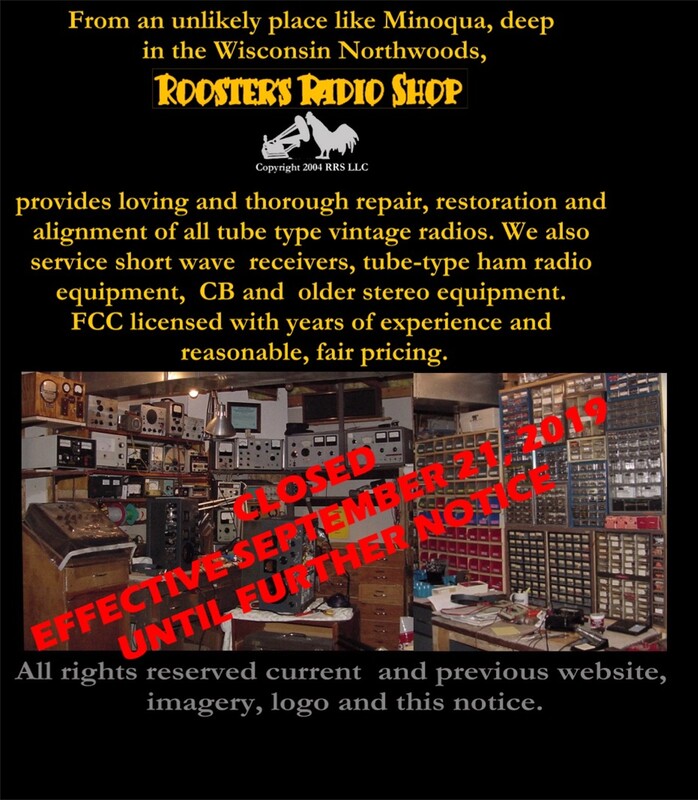
Rooster’s Radio Shop
P.O. Box 85 Woodruff, Wisconsin 54568 (715) 614-9025 E-mail: roostersradioshop@hotmail.com
Since 1967 cherished vintage radios repaired and restored reasonably, promptly and thoroughly. Large and small vacuum tube-type radios shipped safely anywhere, domestically or internationally. But that’s not all. We’re pros at repairing tube-type guitar amplifiers and stereo equipment, too!
Who or What is ROOSTER’S RADIO SHOP ?
A lifelong aficionado of old radios owns Rooster’s. He originally started a two-way radio repair shop in Indiana and Illinois in the 1970s and as he’s moved around the country with his career, has found he enjoys restoring and repairing old time radios more and has turned his focus exclusively on tube-type radios and guitar amplifiers..
He’s a former broadcast engineer and broadcast engineering consultant who designed and built numerous AM and FM radio stations. He’s also served as chief engineer for several radio stations as well as handling the stations’ maintenance, modification and technical supervision. His career path then took him to a manufacturing company in which he was in charge of testing and receiving Underwriter’s Laboratories certification of electrical appliances. Next he joined a major telephone company as a Field Engineer and in charge of maintenance and operation of 3 key microwave relay stations.
Licensing and Certifications
Though licensing is not required for servicing of radio receivers, the following Federal Communications Commission licenses are held:
FCC General Radiotelephone Operator license (licensed in 1982)
FCC First Class Radiotelephone license (licensed in 1970)
FCC Third Class Radiotelegraph license (licensed in 1970)
FCC Amateur radio license (Highest grade) (licensed in 1967)
NABER Technician certificate (1984)
State of New York worthless lottery ticket stub that was supposed to make me rich (1977)
Vintage radio passion.
Since the 1960s he has enjoyed a pastime restoring and repairing older radio equipment and today owns a premium collection of well-restored equipment comprising his fully operational home ham radio station. The station is unique in that it is 100% equipped with vintage equipment. In addition he is a very active short wave listener using, (what else?) all-vintage equipment he has restored.
He is also a regular contributing author to numerous magazines that deal with vintage radio repair and restoration, some may even say he is well known..
Unfortunately, you can’t make a living repairing old radios as much as we wish we could. How does he pay the bills? Since leaving electronics in the late 1970s he is a commercial pilot. Because he is on the road more than he cares to be the phone number will often be answered by an impersonal, digital robot. You can expect a call back as soon as humanly possible however please state your location in the call because Rooster's WILL NOT call you back BEFORE 10:00 AM, between the hours of 4:30 to 7:30 PM (ya gotta eat, right?) or AFTER 8:00 PM in whatever time zone you are located. OK, I'll come clean...I do all I can to avoid being on the road as much as I can, (I say, "If someone else is willing to work my schedule, let them"). HOWEVER the real truth is that here in the Northwoods of Wisconsin, cell phone coverage is...how can I put this nicely...AWFUL. Very likely I am in a dead spot no matter where I am, including home.
We will not return your calls over the weekend or on holidays.
Quality
One of thefirst things you may notice after your vintage radio has been cared for by Rooster’s Radio Shop is that the solder used may not shine brightly. Rooster’s is proud to say that it uses only lead-free solder. Traditional leaded solder is very toxic and, in fact, has been outlawed in some states. Depending upon the composition of the metal that is being soldered, the new solder connection may appear less “shiny.”. THIS IS NOT A POOR SOLDER CONNECTION (known in the trade as a “cold solder joint”). It’s normal. Is lead-free solder expensive? You bet! But we’d rather absorb the cost than both of us absorbing toxic residue.
Whenever possible we try to replace components with ones that look like the originals but manufacturing of electronic parts has advanced enormously over the years and many are now smaller. We also attempt to avoid components manufactured in countries with dubious reputations of their exported products. Most of Rooster’s replacement parts are “new Old stock,” made in the USA and fully checked to ensure fresh performance as well as “new New stock” coming from present day manufacturers in Canada and the U.S.
Payment
Yes, that would be right neighborly of you. We accept cash, check or money orders. No credit cards or third-party online-type shake-down agents. Sorry. We would suggest using money orders for payment for repairs done for radios that are shipped to avoid the delay of a 7 business day bank clearance period.
Questions That Come Up
“Is repairing antique radios expensive?”
While this is a hobby for me, I take on repairs as my time allows. Be aware that while most parts are inexpensive, restoring an old radio is quite labor-intensive. I charge a flat $10/hour. Minimum charge is $10. Most straight repairs need no more than a couple hours of time. However there is a great divide between “repairing” an old radio and “restoring” an old radio.
If you buy a radio without prior knowledge of it, you may be buying one that has sat for a very long time. During that time components physically as well as electrically deteriorate to a point of being damaged if suddenly hit with current. Such a radio will require restoration and not repair. Before any attempt is made to power-up such a radio it must be restored to minimal safety standards, generally all capacitors will have to be replaced and any ancillary components like deteriorated electrical cords replaced. Because a radio "looks good" does not mean it is ship-shape for plugging-in and use! Repair and restoration of a radio can be time consuming and expensive because there usually is at least 10 to 25 hours in labor required. (i.e. 25 hours at $10/hr is $250 for labor alone). Historically our projects are completed within 10 to 20 hours. Restoration does not include cabinet refinishing or repair unless arrangements have been worked out between the customer and the Rooster’s.
Obviously we cannot know until we, layer by layer, dig-in to your radio as to what exactly is necessary for restoral to full functionality. However we also recognize that you may not wish to spend over a certain dollar amount in the event that the radio requires an enormous effort to bring it back to life. For this reason we invite you to set a limit of a certain dollar amount and, as we go deeper into the radio, if we find it will exceed that amount, we will notify you and provide the options available at that point.
In the event that a restoration is necessary, once the defective components have been replaced we proceed cautiously because the radio could have set in storage for many years. We acclimate the radio’s circuit slowly to carrying current again. For 6 hours we will gradually increase the voltage a few volts at a time up to 120 volts. Once the radio has been brought up to the full 120 volts we let the radio operate at idle for 6 more hours to “bake” out any moisture or condensation that may have accumulated over the years inside the transformer or coils.
Repair on the other hand is a more specific service dealing with one or two problems. Other than those problems the radio is considered functional. Generally a specific repair can be completed within 3 to 4 hours.
Rooster’s has little patience with the specter of greed that exists today with all sorts of hidden add-ons to pump up the final cost. A no-obligation estimate prior to proceeding with any repair will always be provided, however it is important to emphasize that an estimate is not a firm and binding price. It’s only an educated guess based on preliminary observation of that which obviously needs to be done. In the case of restoration Rooster’s has no idea of the electrical condition of the radio until powering it up which might not occur until after 20 or more deteriorated parts have been replaced.
Assessments are offered by Rooster’s in which detailed investigation and testing is done to learn the exact “health” Such a comprehensive check-out is billed at the standard $10/hour shop rate and generally requires 3 to 6 hours of time.
"What about my brother-in-law repairing my radio? He knows all about electricity."
Everyone knows a friend or neighbor who is an electronics tinkerer. Rooster's Radio Shop is fully aware of this because we often have to do the clean-up work that has been botched by people who are "in over their head." Repairing vintage radio
requires, minimally, knowledge and skills; but equally important is knowing about the nuances of vintage radios. For instance, did you know that in most old radios the wiring beneath the chassis MUST not be disturbed? While replacing parts, if someone resolders a blue wire that previously ran on top of the red wire, below the red wire, it could upset the delicate balance of the radio's performance and possibly snuff-out sensitivity or introduce hum. The good-and-true engineers and their slide rules back in grandpa's day KNEW what they were doing when they designed and built these radios. A casual electronic hobbyist jumping in today could damage the design criteria.
Very often a botched repair job has many issues: erroneous wiring, components of the wrong value, cold solder joints...the list goes on. It takes a lot of time to trace out and correct someone else's errors. And this can translate to a higher repair bill. A MUCH higher repair bill.
Are parts for vintage radios hard to find or expensive?”
No, not if you know where to look. There is a misconception that tubes or vintage radio parts are rare. Antique stores and online auctions are among the worst places for a serious radio repairman to look for a parts. For this reason Rooster’s focuses on other tried-and-true sources that are less costly and provide higher quality of parts. A very large inventory of parts is obviously maintained. Rooster’s extends the philosophy of honest and fair dealing to the customer. We charge only what we must pay to acquire each part. Unlike auto repair, you will not be charged 3 or 4 times what the shop paid for the part they installed in your car. Because vintage radio parts are not commonly available Rooster’s must be resourceful in scouring the world for parts. Often it’s possible to buy parts that are surprisingly inexpensive and those savings are passed on to the customer. There are rare times when a radio may require a major component such as a transformer, which can be pricier...$20 to $100. You have Rooster’s assurance that whatever is needed will be obtained at the lowest possible cost.
“How long will my radio be tied up in repair?”
We will try to complete repairs within 2 weeks. Occasionally delays will be encountered while we wait for hard-to-find parts or receive documentation that will assist in the repair process. In those cases you will always be apprised of the situation and kept “in the loop.”
“Is work done by ROOSTER’S guaranteed?”
Yes. Should a part be installed to repair your radio that afterward fails, Rooster’s will replace it an no charge. Repairs that did not remedy the customer’s original complaint will be re-done within 7 days of repair without charge. In the unlikely event that the second repair does not correct the problem, the amount paid by the customer will be refunded in full (less any parts that were installed). Sorry, we CANNOT warranty radios in which are provided us outside of its cabinet. Warranty only includes those radios that we remove and re-install in a radio cabinet.
“I have Grand pappy’s and Grand mammy’s old tube radio. I wonder if it works? Should I plug it in?”
PUH LEEZE...resist the temptation!. Old radios have components (resistors and capacitors) which deteriorate over time and can fail. Their failure can results in damage to more expensive and difficult-to-find parts, such as transformers and coils. Have someone knowledgeable inspect the radio before applying power to it.
“What is Grand pappy’s and Grand mammy’s old radio worth?”
This is an impossible question along the lines of "What is my old car worth? (Is it a mint 1964 Ford Mustang convertible or a 1974 Plymouth with 200,000 miles on it?). Most old radios are inexpensive however if you feel you have something special do some research to find the range of their value. Don’t rely on Internet auctions because they tend to be skewed and erroneously valued. .Often their value is thrown off by two overzealous bidders driving the price absurdly high or a beautiful radio unfortunately being auctioned at the wrong time (like over the holidays and going for a give-away price.
Do you repair phonographs?
Our expertise is in electronic devices from the tube-type era. We are very good with vintage radios, short-wave radios, tube-type ham radio equipment, tube-type guitar amplifiers and tube-type stereo equipment. However phonographs are largely mechanical and require special tools, training, talent and parts availability. On-site machine shop capability is often necessary. As such we limit our repair of phonographs to ONLY the electronics subsystems of a phonograph such as the tone arm wiring, the electrical switching, cartridge and the amplifier. We do not service phonographs, Victrolas or tape recorder mechanisms. If you are having a problem with one of these devices we will assess your problem, however if it extends beyond our area of expertise in electronics we will refer you to competent and trustworthy technicians who will properly service the mechanics of your device.
“Do you buy old radios?"
No.
Do you sell old radios?"
No.
“Isn’t transportation a problem, especially for big old console radios?”
Not at all. There are different options available for getting your beloved old radio to Rooster’s
for repair.
1. Drop it off / pick it up yourself. Call or e-mail for directions and let us know approximately
when you plan to arrive. The shop is located approximately 5 miles west of Minocqua, Wisconsin
and is very easy to find. We do not maintain an "open showroom" schedule and are available only by appointment
for pick-up, delivery or consultation.
2. Ship it. If you pack and ship the radio to Rooster’s we will pack and ship it back at no charge other
than the ACTUAL cost of shipping (no add-ons). We pride ourselves on doing as good a job
properly packing a treasured old radio as we do repairing them. You may also drop it off and
arrange to have us pack and ship it back to you. We will be happy to use any shipping carrier you wish,
however, as a general rule FedEx Home Delivery is the least expensive shipping on larger and heavier
items. If you live within their service area, Speedee Delivery is the least costly of any carrier.
We have some cllients who remove the chassis and speaker and ship only those to us for
repair, which is just fine with us.
We have also shipped internationally which, naturally requires special arrangements.
3. We pick up/deliver. Yup, we’ll do either or both, 50 cents per mile.
Terms and conditions stated herein subject to change without notice but will be applied to existing work orders .
P.O. Box 85 Woodruff, Wisconsin 54568 (715) 614-9025 E-mail: roostersradioshop@hotmail.com
Since 1967 cherished vintage radios repaired and restored reasonably, promptly and thoroughly. Large and small vacuum tube-type radios shipped safely anywhere, domestically or internationally. But that’s not all. We’re pros at repairing tube-type guitar amplifiers and stereo equipment, too!
Who or What is ROOSTER’S RADIO SHOP ?
A lifelong aficionado of old radios owns Rooster’s. He originally started a two-way radio repair shop in Indiana and Illinois in the 1970s and as he’s moved around the country with his career, has found he enjoys restoring and repairing old time radios more and has turned his focus exclusively on tube-type radios and guitar amplifiers..
He’s a former broadcast engineer and broadcast engineering consultant who designed and built numerous AM and FM radio stations. He’s also served as chief engineer for several radio stations as well as handling the stations’ maintenance, modification and technical supervision. His career path then took him to a manufacturing company in which he was in charge of testing and receiving Underwriter’s Laboratories certification of electrical appliances. Next he joined a major telephone company as a Field Engineer and in charge of maintenance and operation of 3 key microwave relay stations.
Licensing and Certifications
Though licensing is not required for servicing of radio receivers, the following Federal Communications Commission licenses are held:
FCC General Radiotelephone Operator license (licensed in 1982)
FCC First Class Radiotelephone license (licensed in 1970)
FCC Third Class Radiotelegraph license (licensed in 1970)
FCC Amateur radio license (Highest grade) (licensed in 1967)
NABER Technician certificate (1984)
State of New York worthless lottery ticket stub that was supposed to make me rich (1977)
Vintage radio passion.
Since the 1960s he has enjoyed a pastime restoring and repairing older radio equipment and today owns a premium collection of well-restored equipment comprising his fully operational home ham radio station. The station is unique in that it is 100% equipped with vintage equipment. In addition he is a very active short wave listener using, (what else?) all-vintage equipment he has restored.
He is also a regular contributing author to numerous magazines that deal with vintage radio repair and restoration, some may even say he is well known..
Unfortunately, you can’t make a living repairing old radios as much as we wish we could. How does he pay the bills? Since leaving electronics in the late 1970s he is a commercial pilot. Because he is on the road more than he cares to be the phone number will often be answered by an impersonal, digital robot. You can expect a call back as soon as humanly possible however please state your location in the call because Rooster's WILL NOT call you back BEFORE 10:00 AM, between the hours of 4:30 to 7:30 PM (ya gotta eat, right?) or AFTER 8:00 PM in whatever time zone you are located. OK, I'll come clean...I do all I can to avoid being on the road as much as I can, (I say, "If someone else is willing to work my schedule, let them"). HOWEVER the real truth is that here in the Northwoods of Wisconsin, cell phone coverage is...how can I put this nicely...AWFUL. Very likely I am in a dead spot no matter where I am, including home.
We will not return your calls over the weekend or on holidays.
Quality
One of thefirst things you may notice after your vintage radio has been cared for by Rooster’s Radio Shop is that the solder used may not shine brightly. Rooster’s is proud to say that it uses only lead-free solder. Traditional leaded solder is very toxic and, in fact, has been outlawed in some states. Depending upon the composition of the metal that is being soldered, the new solder connection may appear less “shiny.”. THIS IS NOT A POOR SOLDER CONNECTION (known in the trade as a “cold solder joint”). It’s normal. Is lead-free solder expensive? You bet! But we’d rather absorb the cost than both of us absorbing toxic residue.
Whenever possible we try to replace components with ones that look like the originals but manufacturing of electronic parts has advanced enormously over the years and many are now smaller. We also attempt to avoid components manufactured in countries with dubious reputations of their exported products. Most of Rooster’s replacement parts are “new Old stock,” made in the USA and fully checked to ensure fresh performance as well as “new New stock” coming from present day manufacturers in Canada and the U.S.
Payment
Yes, that would be right neighborly of you. We accept cash, check or money orders. No credit cards or third-party online-type shake-down agents. Sorry. We would suggest using money orders for payment for repairs done for radios that are shipped to avoid the delay of a 7 business day bank clearance period.
Questions That Come Up
“Is repairing antique radios expensive?”
While this is a hobby for me, I take on repairs as my time allows. Be aware that while most parts are inexpensive, restoring an old radio is quite labor-intensive. I charge a flat $10/hour. Minimum charge is $10. Most straight repairs need no more than a couple hours of time. However there is a great divide between “repairing” an old radio and “restoring” an old radio.
If you buy a radio without prior knowledge of it, you may be buying one that has sat for a very long time. During that time components physically as well as electrically deteriorate to a point of being damaged if suddenly hit with current. Such a radio will require restoration and not repair. Before any attempt is made to power-up such a radio it must be restored to minimal safety standards, generally all capacitors will have to be replaced and any ancillary components like deteriorated electrical cords replaced. Because a radio "looks good" does not mean it is ship-shape for plugging-in and use! Repair and restoration of a radio can be time consuming and expensive because there usually is at least 10 to 25 hours in labor required. (i.e. 25 hours at $10/hr is $250 for labor alone). Historically our projects are completed within 10 to 20 hours. Restoration does not include cabinet refinishing or repair unless arrangements have been worked out between the customer and the Rooster’s.
Obviously we cannot know until we, layer by layer, dig-in to your radio as to what exactly is necessary for restoral to full functionality. However we also recognize that you may not wish to spend over a certain dollar amount in the event that the radio requires an enormous effort to bring it back to life. For this reason we invite you to set a limit of a certain dollar amount and, as we go deeper into the radio, if we find it will exceed that amount, we will notify you and provide the options available at that point.
In the event that a restoration is necessary, once the defective components have been replaced we proceed cautiously because the radio could have set in storage for many years. We acclimate the radio’s circuit slowly to carrying current again. For 6 hours we will gradually increase the voltage a few volts at a time up to 120 volts. Once the radio has been brought up to the full 120 volts we let the radio operate at idle for 6 more hours to “bake” out any moisture or condensation that may have accumulated over the years inside the transformer or coils.
Repair on the other hand is a more specific service dealing with one or two problems. Other than those problems the radio is considered functional. Generally a specific repair can be completed within 3 to 4 hours.
Rooster’s has little patience with the specter of greed that exists today with all sorts of hidden add-ons to pump up the final cost. A no-obligation estimate prior to proceeding with any repair will always be provided, however it is important to emphasize that an estimate is not a firm and binding price. It’s only an educated guess based on preliminary observation of that which obviously needs to be done. In the case of restoration Rooster’s has no idea of the electrical condition of the radio until powering it up which might not occur until after 20 or more deteriorated parts have been replaced.
Assessments are offered by Rooster’s in which detailed investigation and testing is done to learn the exact “health” Such a comprehensive check-out is billed at the standard $10/hour shop rate and generally requires 3 to 6 hours of time.
"What about my brother-in-law repairing my radio? He knows all about electricity."
Everyone knows a friend or neighbor who is an electronics tinkerer. Rooster's Radio Shop is fully aware of this because we often have to do the clean-up work that has been botched by people who are "in over their head." Repairing vintage radio
requires, minimally, knowledge and skills; but equally important is knowing about the nuances of vintage radios. For instance, did you know that in most old radios the wiring beneath the chassis MUST not be disturbed? While replacing parts, if someone resolders a blue wire that previously ran on top of the red wire, below the red wire, it could upset the delicate balance of the radio's performance and possibly snuff-out sensitivity or introduce hum. The good-and-true engineers and their slide rules back in grandpa's day KNEW what they were doing when they designed and built these radios. A casual electronic hobbyist jumping in today could damage the design criteria.
Very often a botched repair job has many issues: erroneous wiring, components of the wrong value, cold solder joints...the list goes on. It takes a lot of time to trace out and correct someone else's errors. And this can translate to a higher repair bill. A MUCH higher repair bill.
Are parts for vintage radios hard to find or expensive?”
No, not if you know where to look. There is a misconception that tubes or vintage radio parts are rare. Antique stores and online auctions are among the worst places for a serious radio repairman to look for a parts. For this reason Rooster’s focuses on other tried-and-true sources that are less costly and provide higher quality of parts. A very large inventory of parts is obviously maintained. Rooster’s extends the philosophy of honest and fair dealing to the customer. We charge only what we must pay to acquire each part. Unlike auto repair, you will not be charged 3 or 4 times what the shop paid for the part they installed in your car. Because vintage radio parts are not commonly available Rooster’s must be resourceful in scouring the world for parts. Often it’s possible to buy parts that are surprisingly inexpensive and those savings are passed on to the customer. There are rare times when a radio may require a major component such as a transformer, which can be pricier...$20 to $100. You have Rooster’s assurance that whatever is needed will be obtained at the lowest possible cost.
“How long will my radio be tied up in repair?”
We will try to complete repairs within 2 weeks. Occasionally delays will be encountered while we wait for hard-to-find parts or receive documentation that will assist in the repair process. In those cases you will always be apprised of the situation and kept “in the loop.”
“Is work done by ROOSTER’S guaranteed?”
Yes. Should a part be installed to repair your radio that afterward fails, Rooster’s will replace it an no charge. Repairs that did not remedy the customer’s original complaint will be re-done within 7 days of repair without charge. In the unlikely event that the second repair does not correct the problem, the amount paid by the customer will be refunded in full (less any parts that were installed). Sorry, we CANNOT warranty radios in which are provided us outside of its cabinet. Warranty only includes those radios that we remove and re-install in a radio cabinet.
“I have Grand pappy’s and Grand mammy’s old tube radio. I wonder if it works? Should I plug it in?”
PUH LEEZE...resist the temptation!. Old radios have components (resistors and capacitors) which deteriorate over time and can fail. Their failure can results in damage to more expensive and difficult-to-find parts, such as transformers and coils. Have someone knowledgeable inspect the radio before applying power to it.
“What is Grand pappy’s and Grand mammy’s old radio worth?”
This is an impossible question along the lines of "What is my old car worth? (Is it a mint 1964 Ford Mustang convertible or a 1974 Plymouth with 200,000 miles on it?). Most old radios are inexpensive however if you feel you have something special do some research to find the range of their value. Don’t rely on Internet auctions because they tend to be skewed and erroneously valued. .Often their value is thrown off by two overzealous bidders driving the price absurdly high or a beautiful radio unfortunately being auctioned at the wrong time (like over the holidays and going for a give-away price.
Do you repair phonographs?
Our expertise is in electronic devices from the tube-type era. We are very good with vintage radios, short-wave radios, tube-type ham radio equipment, tube-type guitar amplifiers and tube-type stereo equipment. However phonographs are largely mechanical and require special tools, training, talent and parts availability. On-site machine shop capability is often necessary. As such we limit our repair of phonographs to ONLY the electronics subsystems of a phonograph such as the tone arm wiring, the electrical switching, cartridge and the amplifier. We do not service phonographs, Victrolas or tape recorder mechanisms. If you are having a problem with one of these devices we will assess your problem, however if it extends beyond our area of expertise in electronics we will refer you to competent and trustworthy technicians who will properly service the mechanics of your device.
“Do you buy old radios?"
No.
Do you sell old radios?"
No.
“Isn’t transportation a problem, especially for big old console radios?”
Not at all. There are different options available for getting your beloved old radio to Rooster’s
for repair.
1. Drop it off / pick it up yourself. Call or e-mail for directions and let us know approximately
when you plan to arrive. The shop is located approximately 5 miles west of Minocqua, Wisconsin
and is very easy to find. We do not maintain an "open showroom" schedule and are available only by appointment
for pick-up, delivery or consultation.
2. Ship it. If you pack and ship the radio to Rooster’s we will pack and ship it back at no charge other
than the ACTUAL cost of shipping (no add-ons). We pride ourselves on doing as good a job
properly packing a treasured old radio as we do repairing them. You may also drop it off and
arrange to have us pack and ship it back to you. We will be happy to use any shipping carrier you wish,
however, as a general rule FedEx Home Delivery is the least expensive shipping on larger and heavier
items. If you live within their service area, Speedee Delivery is the least costly of any carrier.
We have some cllients who remove the chassis and speaker and ship only those to us for
repair, which is just fine with us.
We have also shipped internationally which, naturally requires special arrangements.
3. We pick up/deliver. Yup, we’ll do either or both, 50 cents per mile.
Terms and conditions stated herein subject to change without notice but will be applied to existing work orders .